By Maxwell Menkiti Ngene
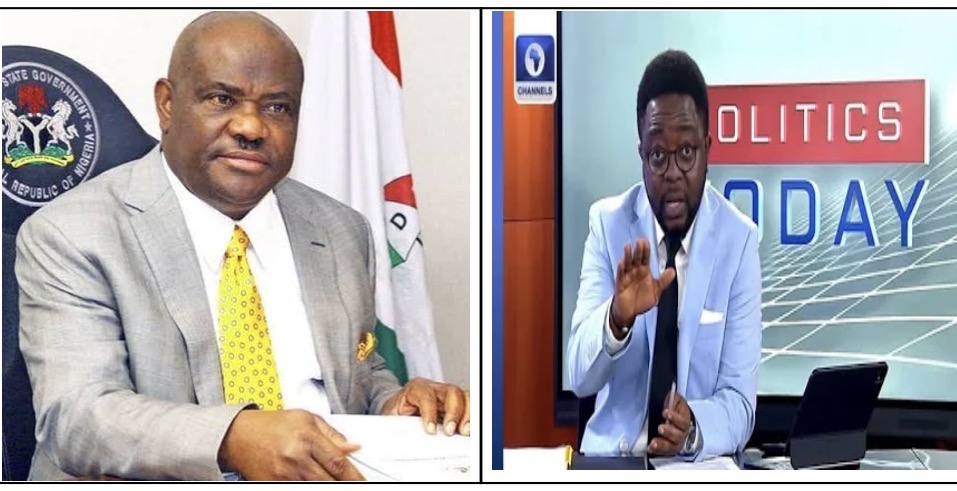
The recent verbal altercation between Nigeria’s Minister of the Federal Capital Territory, Nyesom Wike, and Channels Television anchor Seun Okinbaloye serves as a critical case study in the fragility of democratic institutions. Dr. Maxwell Menkiti Ngene analyzes the dual failure of professional boundary-setting: a journalist’s slide into partisan language and a state official’s resort to the rhetoric of violence. This piece argues that for democracy to thrive, the “space between the microphone and the gun” must be protected by both professional discipline and ministerial restraint.
The drama that unfolded between Nyesom Wike, Nigeria’s Minister of the Federal Capital Territory, and Channels Television’s revered anchor Seun Okinbaloye recently has done what Nigerian controversies often do: generate enormous heat and very little light. Social media has been awash with the story, taking sides along predictably political lines. Wike’s supporters have cheered; Seun’s defenders have raged. Yet, somewhere in the noise, two genuinely important questions have gone unanswered: Did Seun cross a professional line? And was Wike’s response acceptable from a man who holds one of the most powerful offices in the land? The honest answer to both questions is “Yes.” And that honesty is precisely what this conversation genuinely needs.
Seun’s Sin: The Journalist Who Forgot His Toga
Seun Okinbaloye is not a newcomer to Nigerian broadcasting. He is one of the most recognizable faces on Channels Television, a platform that has built its reputation on the idea of independent, agenda-free journalism. When you sit behind that desk, you carry that brand; you carry the trust of millions of Nigerians who tune in expecting a professional, not a partisan.
So when Seun said on live television that “they” would not allow a one-party state in Nigeria, he did not merely stumble. He fell. That single word—**”they”**—is the problem. Not the sentiment, necessarily, but the language and the platform. “They” implies membership. It implies that Seun has a side, a camp, a stake in the political contest he is supposed to be refereeing. For a journalist of his stature, that is an extraordinary lapse. The moment an anchor speaks in the language of political solidarity on air, the trust of a monolithic audience begins to crack. While some argue that journalistic neutrality is a luxury during times of democratic threat, even the tradition of adversarial journalism demands discipline: you declare your position as advocacy. You do not slip into the language of solidarity while wearing the coat of an objective broadcaster. That is not courage; it is confusion.
Wike’s Words: When Power Reaches for the Trigger
If Seun’s error was one of professional judgment, Wike’s response was a failure of something far more serious: a failure to understand what democratic governance requires of those who hold power. Wike stated he felt like “shooting” Seun through the television screen. His defenders dismiss this as hyperbole or colorful Nigerian vent. But Wike is not a private citizen. He is a sitting Minister of the Federal Republic. When a high-ranking official declares, even figuratively, a desire to shoot a journalist, those words travel. In a country where journalists have historically been harassed, detained, and killed, such language is not a joke. It is a signal of highhandedness and a lack of respect for life as a primary value.
What makes Wike’s outburst more troubling is his “moral framing.” He positioned himself as a defender of journalistic ethics while simultaneously threatening a journalist. If Wike had a legitimate grievance, democratic avenues were available:
1. A formal complaint to Channels Television management.
2. A petition to the Nigeria Broadcasting Commission (NBC).
3. A measured public rebuttal through his media team.
Instead, the Minister chose the language of intimidation. That is not governance; it is a regression to the “habit of the crucible.”
The Standard We Must Demand
There is a reason we hold journalists and judges to similar standards of neutrality. Both occupy positions of public trust derived from perceived impartiality. The moment a journalist is seen to favor a party, his reportage loses credibility, regardless of its factual accuracy. The “toga” is the very source of the power the profession wields.
Wike, for his part, must reckon with a truth that power often obscures: his office is held in trust for the Nigerian people. A minister who responds to press conduct with the language of physical violence tells us exactly how he conceives the relationship between the government and the Fourth Estate. It is not a reassuring picture. The reflexive tribalism of social media—cheering Wike or defending Seun based on political leanings—creates the environment where both the abuse of press freedom and the intimidation of the press thrive. When we make every controversy a matter of “which team wins” rather than “which principle holds,” we weaken our institutions. Seun Okinbaloye is not the property of any political party. Nyesom Wike is not above the democratic norms that govern public speech. Holding both truths simultaneously requires an intellectual honesty that modern discourse often discourages.
Conclusion: Both Men Owe Nigeria Better
Strip away the noise and what remains is a portrait of two institutions under strain: Nigerian journalism and Nigerian democracy itself. A press that cannot maintain independence and a political class that responds to scrutiny with threats are two sides of the same dysfunctional coin. Seun must return to the professional discipline that carved a niche for him. His power lies in the questions he asks, not the positions he takes. Wike must be reminded that political capital is not a license to silence voices. Between the microphone and the gun, there is a wide and important space. It is the space where democracy breathes. Both men, for a moment, forgot that. It is not too late for either of them to remember.
Maxwell Menkiti Ngene, Ph.D. (Senior Fellow / Contributor, Center for Media and Peace Initiatives) is a Senior Lecturer in the Department of Mass Communication, Enugu State University of Science and Technology (ESUT).